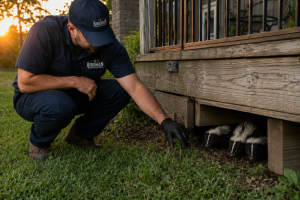

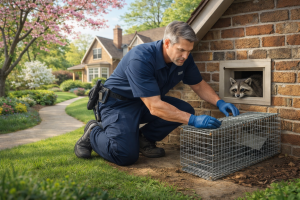
If you’ve caught a faint whiff of something musky near your deck, porch, or crawlspace lately, don’t brush it off. June and July mark the peak of baby skunk season in Middle Tennessee, and what starts as a minor nuisance can escalate into a serious problem if not handled quickly and correctly. Here’s what Nashville homeowners need to know right now.
Understanding Baby Skunk Season
Skunks in Tennessee typically give birth between May and June, with litters averaging four to seven kits. By late June, those kits are mobile — curious, poorly coordinated, and startled easily. That’s a dangerous combination when they’ve taken up residence under your deck or in your crawlspace.
Baby skunks are capable of spraying as early as eight days old, and unlike adult skunks that typically give warning signals before spraying, young skunks are far more unpredictable. A dog, a child, or even a startled footstep on a deck can trigger a spray response with almost no warning.
By July, litters begin to disperse as they approach independence, which means one family unit under your deck can quickly become multiple skunks exploring your entire property.
Where Skunks Nest on Nashville Properties
Skunks are opportunistic nesters. They’re not building elaborate dens — they’re looking for existing shelter that’s dark, quiet, and close to food. The most common nesting locations on Nashville residential properties include:
- Under decks and porches — The single most common location. Easy access, protection from predators, and proximity to the yard where they forage.
- Crawlspaces — Skunks can squeeze through surprisingly small foundation gaps. Once inside, they’re extremely difficult to remove without professional help.
- Under concrete stoops and steps — The gap beneath a front stoop is a favorite.
- Around HVAC equipment — Warmth and shelter make this an attractive spot.
- Under storage sheds — Particularly sheds with open gaps along the base.
If you smell skunk near any of these locations — even faintly — there’s a good chance a family has moved in.
Why You Should Never Try to Remove Skunks Yourself
We get it. The DIY instinct kicks in and you think, “I’ll just chase them out.” Here’s why that almost always makes things worse:
Startling a skunk guarantees a spray. Adult skunks give warning signals — stomping, tail raising — but panicked young skunks don’t. Any attempt to rush, trap without guidance, or physically remove skunks without proper technique is almost guaranteed to result in a spray event that can affect your home, pets, and family.
Skunk spray is extremely difficult to remove. Standard tomato juice or dish soap doesn’t work well. Professional-grade neutralizers are needed for effective deodorization, especially if a pet or interior space is affected.
Separating a mother from her kits creates a bigger problem. If a mother skunk is removed but her kits remain, they’ll cry out and die in place — creating an odor problem that can last weeks. Proper removal requires addressing the entire family unit together.
Tennessee wildlife regulations apply. Skunks are classified as nuisance wildlife in Tennessee, but removal must still be handled in accordance with state regulations. Our technicians are fully certified and compliant.
How Birdman Handles Baby Skunk Removal
Birdman’s approach to skunk removal during baby season is methodical and thorough:
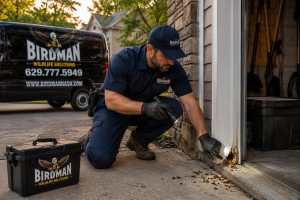
- Property assessment — We identify the nesting site, determine the size of the family, and evaluate all potential access points.
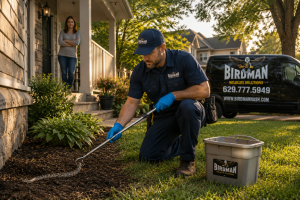
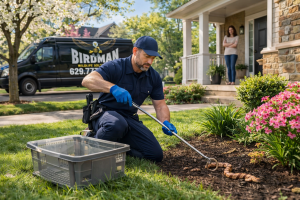
- Humane exclusion and trapping — We use odor-minimizing techniques and professional-grade humane traps designed specifically for skunk removal. Our technicians are experienced in approaching and handling skunks without triggering a spray.
- Full family removal — We ensure the mother and all kits are removed together and relocated appropriately.
- Access point sealing — Once the skunks are gone, we seal the entry points they used to prevent re-entry by skunks or other wildlife.
- Deodorization if needed — If any spraying occurred, we can treat the affected area with professional neutralizing agents.
Don’t Wait for a Spray Event
The homeowners who call us after a spray event always say the same thing: “I knew they were there, I just kept putting it off.” Baby skunk season moves fast. A family under your deck in June can mean multiple dispersing juveniles exploring your property by late July.
The sooner you call, the simpler and less expensive the removal process is — and the less likely you are to deal with a spray situation.